After a car accident, it’s normal to have questions about what happens next and what information may affect your claim. If police responded to your crash in South Carolina, the officer most likely completed a TR-310 Traffic Collision Report, which serves as the official record of the accident. Insurance companies often review this report when determining who may be at fault. At Lowcountry Law, Matthew Breen, your car accident lawyer, can request and review your TR-310 with you, helping you understand what it says and what it may mean for your claim.
What Is the South Carolina TR-310 Crash Report?
The TR-310, formally called the South Carolina Traffic Collision Report Form, is the written report a law enforcement officer completes after investigating a crash. Every police department, sheriff’s office, and the South Carolina Highway Patrol uses the same standard form, so a crash on Coleman Boulevard is documented the same way as one on I-26.
The officer files the report electronically with the state. It’s more detailed than the slip of paper you were handed before you left the scene. That slip is a separate form (explained below).
What Information Is on the Crash Report?
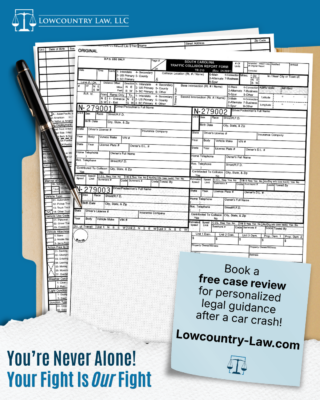 While the details are still fresh, the responding officer gathers and records as much information as possible. A typical TR-310 includes:
- The date, time, and exact location of the collision
- Names and contact details for drivers, passengers, owners, and witnesses
- Vehicle details, including plate numbers, VINs, damage, and whether a car was towed
- Insurance information for each vehicle
- Injury information for each person and whether anyone was taken for medical care
- Road, lighting, and weather conditions
- A written narrative of how the crash happened
- A diagram showing lanes, vehicle positions, and points of impact
- Contributing factors the officer noted for each driver, such as speeding, distraction, or failure to yield
- Any citations issued and any alcohol or drug testing results
Insurance adjusters often look at the narrative, diagram, and contributing factors first because these sections can show how the officer understood the crash and who may have caused it.
TR-310 vs. FR-10: Which Form Did You Get at the Scene?
Before you left the scene, the officer likely gave you a short form called the FR-10. This is the copy drivers take home with them. It includes basic details about the crash, along with insurance information for each driver.
The FR-10 is helpful, but it is not the full crash report. It doesn’t include the officer’s narrative or diagram. Hold on to it, though. The report number on your FR-10 makes it easier to request the complete TR-310 later.
How To Get a Copy of Your Report in South Carolina
You do not automatically receive the full report. You request it from the South Carolina Department of Motor Vehicles in one of three ways:
- Online through the SCDMV website. You enter your personal information first to confirm you are allowed to see the report.
- In person by filling out Form FR-50, Request for Copy of Collision Report, and bringing it to any SCDMV branch.
- By mail by sending two completed copies of Form FR-50 with a check or money order to the address on the form.
The fee is $10 per report. Crash reports are not available to the general public, so you will need details like the crash date, county, and your FR-10 information to request one.
When you work with Lowcountry Law, Matthew Breen can request the report for you, so you have one less thing to handle while you recover.
What if Police Did Not Write a TR-310?
Sometimes officers don’t come to the scene, or they arrive but don’t investigate. This happens often with crashes that occur in parking lots or on private property. In that case, South Carolina law requires you to file the required crash report.
Under S.C. Code § 56-5-1270, if a crash is not investigated by law enforcement and causes injury, death, or $1,000 or more in total property damage, the driver or owner must complete Form FR-309, Traffic Collision Report, and send it to the SCDMV within 15 days. Your insurance agent or company must complete the insurance section before you send it.
Missing the 15-day window can create problems with the DMV. It also leaves your claim without an official crash record. If you were hurt and no officer wrote a report, call Lowcountry Law early so we can file the FR-309 correctly and preserve other evidence, like photos and witness names.
How a Mount Pleasant Car Accident Lawyer Uses the TR-310 in Your Injury Claim
In South Carolina, recovering compensation usually means showing that another driver was careless and that their carelessness caused your injuries. The TR-310 often provides some of the first information used to support your claim.
Showing Who Was at Fault
When the officer lists contributing factors or issues a citation to the other driver, that is early support for your claim. The narrative and diagram also help us explain the crash to an insurance adjuster in a format they’re used to reading.
Fault can significantly affect your claim. South Carolina uses a modified comparative negligence rule. You can still recover money if you were not more than 50% at fault, but your compensation is reduced by your share of the blame. If a report suggests you were partly at fault, the insurance company will use it to lower its offer.
Matthew Breen can help you evaluate a settlement offer and push back if the insurance company offers less than your claim may be worth.
Finding Every Source of Insurance
The report lists every driver, vehicle owner, and insurer involved in the collision. We use it to identify all the policies that may cover your losses, including commercial policies when a work truck or company vehicle was involved.
Connecting Your Injuries to the Crash
We compare the injury and damage details in the report with your medical records. This helps show how the crash caused your specific injuries, supporting your claim for medical bills, lost wages, and pain and suffering.
Catching Mistakes in the Report
Officers work quickly, and reports can contain errors. A wrong lane, a missing witness, or an inaccurate statement can hurt your claim. If something in your TR-310 looks wrong, we can gather photos, video, witness accounts, and other evidence to set the record straight. The report is important, but it is not the final word on what happened.
Talk to a Car Accident Lawyer in Mount Pleasant About Your Crash Report
Your TR-310 is an important document in a South Carolina car accident claim. It is the officer’s official account of what happened, and insurance companies lean on it when deciding what to offer you. Knowing what your report says, and whether it is accurate, puts you in a stronger position from the start.
Lowcountry Law helps injured people in Mount Pleasant, Charleston, and throughout the Lowcountry navigate the claims process and protect their interests after an accident. We can request your crash report, review it with you, and use it to build your claim against the at-fault driver’s insurance. Schedule a FREE case review to get started.